
 By
By“Doctor, is hymenoplasty painful or risky?”
This is often the very first question a woman asks me during consultation. In my experience, the concern is rarely only about pain. It is about safety, privacy, and the fear that something may go wrong. Many women come to me after reading confusing or exaggerated information online, unsure of what to believe.
When patients search is hymenoplasty painful or risky, they are not looking for reassurance without facts. They want honest medical clarity. As a doctor, I believe it is my responsibility to explain this procedure exactly as it is—without exaggeration, without guarantees, and without social judgement.
Hymenoplasty is a minor surgical procedure, but it must be approached thoughtfully. If you are not familiar with the procedure itself, you can first understand what hymenoplasty surgery involves before reading further about pain, risks, and recovery. Many people misunderstand its pain, risks, and success because myths and social beliefs often overshadow medical facts. In this article, I explain the real pain levels you can expect, clarify the actual medical risks versus myths, describe what safety under proper medical supervision truly means, explain how doctors measure success, and guide you on choosing a qualified provider in Delhi.
I did not write this article to persuade you to have surgery. I wrote it to help you make a clear, pressure-free decision based on medical facts. When a qualified doctor performs hymenoplasty under proper supervision, it is generally safe—but it is never a solution for social pressure or expectations.
Every woman’s body is different. Every situation is personal. My role is to give you clear information so that your decision, whatever it may be, feels calm, informed, and truly your own.
All medical information reviewed and verified by Dr Sandeep Bhasin, Senior Cosmetic Surgeon, Delhi.
Last medically reviewed: February 2026
Should You Consider Hymenoplasty? Understanding Your Decision
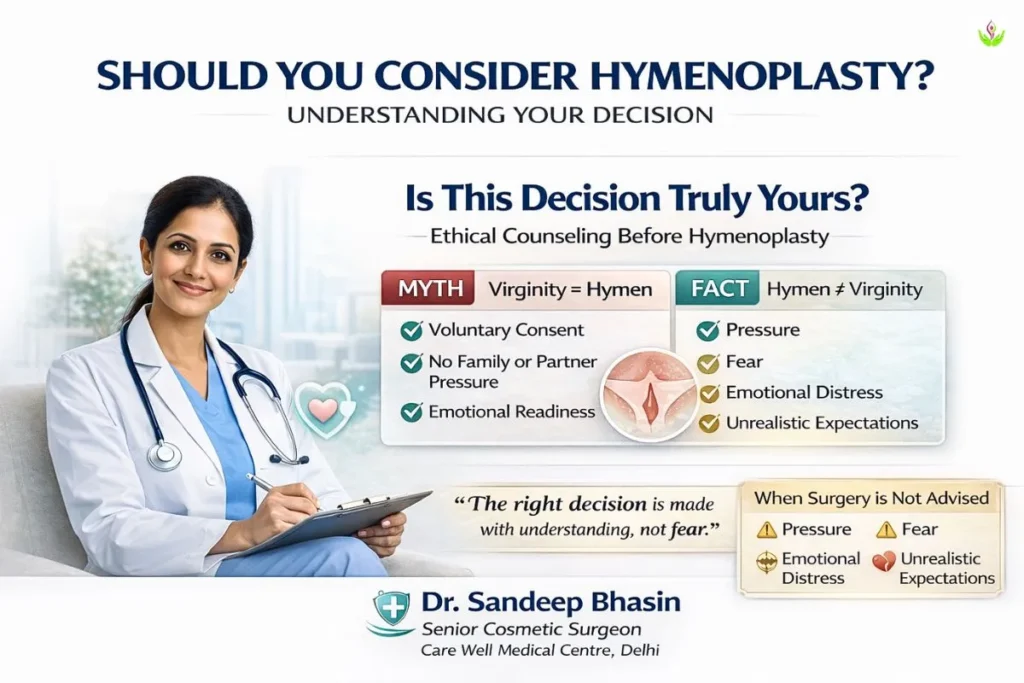
Before we talk about pain or risks, I always ask my patients one important question:
“Is this decision truly yours?”
In my practice, this matters as much as the surgery itself.
The Role of Pre-Procedure Counseling (Ethical Foundation)
I never perform hymenoplasty without counseling first. This is not a formality—it is part of responsible medical care.
During counseling, I personally take time to understand:
- Whether your consent is voluntary and informed, without anyone influencing you
- If you feel safe and comfortable discussing your reason for considering surgery
- Whether the decision comes from your own choice, not fear or pressure
- If you feel emotionally prepared for the procedure and recovery
If I sense hesitation, confusion, or pressure, I pause the process. I never perform surgery when a patient is in emotional distress.
Virginity – Medical Reality vs Social Belief
I explain this clearly to every patient: medically, the hymen does not define virginity.
What I want you to understand is:
- Virginity is a social belief, not a medical diagnosis
- The hymen can stretch or tear due to non-sexual reasons, or may be minimal naturally
- Hymenoplasty only reconstructs tissue—it does not change life history or personal value
I discuss this openly because no woman should feel ashamed of her body. Your emotional wellbeing matters far more than meeting social expectations.
When I May Advise Against Surgery
There are times when I do not recommend hymenoplasty, even if it is technically possible.
I may say no if I see:
- Signs that you are being pressured or threatened by someone
- Expectations that surgery will solve relationship or social problems
- High anxiety or emotional distress that needs counseling, not surgery
Saying no in these situations is part of my responsibility as a doctor. My role is not only to operate, but to protect your physical and emotional health.
My Final Thought on This Decision
If you decide to proceed after proper counseling, I support you fully. If you decide not to, that is equally valid. You make the right decision when you choose calmly, with understanding—not fear.
Is Hymenoplasty Legal in India? Complete Legal & Privacy Guide

This is one of the most common concerns patients raise quietly but urgently. Before discussing any procedure, I always explain the legal position and privacy safeguards clearly, because peace of mind begins with knowing your rights.
Legal Status Under Indian Law
Indian law permits hymenoplasty when an adult patient gives informed consent.
- Hymenoplasty is fully legal when the patient is an adult and consents voluntarily
- It has no connection with the Medical Termination of Pregnancy (MTP) Act
- It is classified as an elective cosmetic or reconstructive procedure, not a criminal or prohibited act
Indian law permits hymenoplasty when doctors perform it ethically, safely, and with proper consent.
Age & Consent Requirements
Indian medical law places strong emphasis on patient autonomy and informed consent.
- The minimum legal age is 18 years
- You must provide a valid government-issued ID to confirm your age.
- Written informed consent is mandatory before surgery
- An adult patient does not need parental, partner, or spousal permission.
As a doctor, I ensure that the patient gives informed, voluntary, and pressure-free consent.
Privacy & Confidentiality Protection
Privacy is often a bigger concern than the surgery itself. I take this extremely seriously.
- Your medical information is protected under medical confidentiality laws
- No details are shared with family members, partners, or third parties without your explicit consent
- Hymenoplasty is not covered by insurance, which further limits external disclosure
- Digital medical records are maintained securely, with restricted access
Your consultation, procedure, and records remain confidential. Disclosure happens only if you choose it.
Doctor’s Legal Responsibilities
The law also places clear responsibilities on the treating doctor.
- Proper documentation and informed consent are mandatory
- The procedure must be performed by a registered and qualified medical professional
- The patient has the right to refuse or withdraw consent at any stage before surgery
- A doctor is ethically and legally allowed to decline the procedure if consent is unclear or coercion is suspected
These safeguards exist to protect you as a patient, not to complicate your care.
Doctor’s Perspective
Understanding the legal and privacy framework often reduces a great deal of anxiety. When I approach hymenoplasty transparently, ethically, and within the law, patients can focus on what truly matters: their safety, wellbeing, and informed choice.
In the next section, I will address a concern that almost every patient has before surgery: how painful hymenoplasty actually is, during and after the procedure.
How Painful Is Hymenoplasty Surgery?
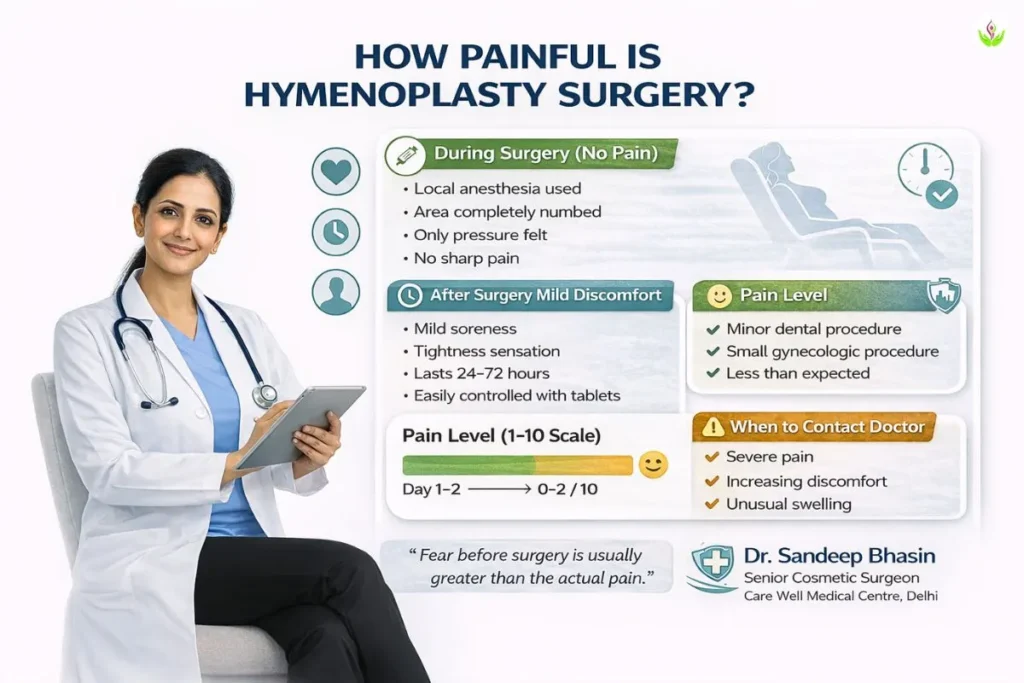
Pain is usually the first fear patients express, and understandably so. I address this very clearly during consultation, because knowing what to expect removes much of the anxiety.
Pain During the Procedure
I perform hymenoplasty under local anesthesia, which completely numbs the surgical area before I begin.
- Local anesthesia blocks pain signals from the area
- You remain comfortable and conscious, without feeling sharp pain
- During the procedure, patients typically feel pressure or movement, not pain
Because the tissue involved is superficial and well anesthetized, the surgery itself is painless. If a patient feels any discomfort at any point, I adjust the anesthesia immediately.
Pain After Surgery (The Reality)
After the anesthesia wears off, some discomfort is normal, but it is usually mild.
What most patients experience:
- Mild soreness or tightness, not severe pain
- A sensation similar to a minor cut or abrasion
- Discomfort that typically lasts 24 to 72 hours
On a standard pain scale of 1 to 10, most patients rate post-operative discomfort between 2 and 4 during the first 48 hours, decreasing to 0–2 by the third day.
Routine oral pain medication usually controls pain well, and patients rarely need strong painkillers. By the second or third day, most patients report significant improvement and are able to resume light daily activities such as desk work, walking, and self-care, while avoiding squatting, heavy lifting, or strenuous exercise.
Severe or worsening pain is uncommon when patients follow post-operative instructions, and patients should report it immediately if it occurs.
Pain Comparison (Setting the Right Expectation)
To help patients understand this realistically, I often compare hymenoplasty recovery pain to:
- A minor dental procedure, such as a simple tooth extraction
- A small gynecologic procedure involving superficial tissue
Most patients later tell me that the discomfort was much less than they had imagined. In my experience, fear before surgery is usually greater than the actual pain afterward.
When I perform the procedure carefully and patients follow post-operative care properly, hymenoplasty ranks among the less painful minor surgical procedures.
The next concern patients usually raise is not pain, but safety and possible risks, which I will explain clearly in the following section.
Is Hymenoplasty Safe Under Medical Supervision?
Safety is the next concern patients usually raise after pain. In my experience, proper medical supervision makes hymenoplasty a safe procedure, and understanding this helps reduce unnecessary fear.
Why Hymenoplasty Is Medically Low-Risk
From a medical standpoint, hymenoplasty is a low-risk procedure for three main reasons:
- It involves only superficial vaginal tissue and does not go deep into the body
- There is no involvement of the uterus, ovaries, or internal reproductive organs
- The surgical time is short, usually completed within a brief, controlled setting
Because the procedure involves only the outer vaginal tissue, it does not affect hormonal function, fertility, menstruation, or future childbirth. When done correctly, the overall medical risk remains low.
To put this in perspective, hymenoplasty carries similar or lower risk compared to other common outpatient procedures such as simple dental extractions, minor skin biopsies, or episiotomy repair. It does not require general anesthesia, does not involve major blood vessels, and typically heals within the same timeframe as a minor laceration.
What Makes Hymenoplasty Safe
Safety depends not only on the procedure, but on how and where the doctor performs it. I always explain to patients that outcomes depend heavily on medical standards.
Hymenoplasty is safest when:
- A qualified and registered surgeon performs the procedure.
- The procedure takes place in a properly equipped, sterile operation theatre (OT).
- There is thorough pre-procedure screening, including medical history and examination
- Clear post-operative instructions and follow-up are provided
When a qualified doctor performs hymenoplasty under proper medical supervision, complications remain uncommon and usually minor. Unsafe settings, poor sterilization, untrained providers, and lack of follow-up care significantly increase the risk of problems.
My role as a doctor is not only to perform surgery, but to ensure that every safety protocol is followed before, during, and after the procedure. When hymenoplasty is performed as safe hymenoplasty under doctor supervision, complications are uncommon and usually minor.
In the next section, I will explain the possible risks and side effects, because informed decisions require understanding both safety and limitations.
Is Hymenoplasty Risky or Dangerous?
This is an important question, and I answer it honestly during every consultation. When doctors perform hymenoplasty correctly, they do not consider it dangerous, but it still carries some risks like any minor surgery. Understanding these calmly helps you make an informed decision without unnecessary fear.
Possible Medical Risks (Rare)
When a qualified doctor performs hymenoplasty under proper medical supervision, complications remain uncommon and usually mild. The possible medical risks include:
- Infection:
Following proper sterile technique keeps this risk rare. Prevented with proper hygiene and, when indicated, short-term medication. - Bleeding:
Usually minimal and self-limiting. The absence of major blood vessels makes significant bleeding uncommon. - Stitch discomfort:
Patients may feel a mild pulling or tight sensation while the stitches heal. This settles as absorbable stitches dissolve naturally.
In my experience, most patients avoid serious problems when they follow post-operative instructions carefully.
Why Serious Complications Are Uncommon
There are clear medical reasons why hymenoplasty has a low complication rate:
- The procedure is performed in a controlled surgical field, reducing contamination
- Absorbable stitches are used, lowering infection risk and avoiding stitch removal
- Post-operative monitoring and follow-up allow early identification of concerns
Because the surgery involves only superficial tissue and does not affect internal organs, serious complications are rare, not expected.
I always emphasize this: unsafe settings, poor sterilization, lack of surgical expertise, and inadequate follow-up increase the risk of complications. When a qualified doctor performs hymenoplasty responsibly, the procedure remains low-risk, not dangerous.
When to Contact Your Doctor
Although complications are rare, it is important to know when to seek medical advice. You should contact your doctor if you experience:
- Heavy bleeding that soaks a pad within one hour
- Fever above 100.4°F (38°C) or chills
- Severe pain not controlled by prescribed medication
- Foul-smelling discharge or unusual odor
- Increasing swelling or redness after the first three days
Most recovery-related concerns are minor and expected, but these signs require medical evaluation. Early communication helps resolve issues quickly and prevents complications from worsening.
In the next section, I explain hymenoplasty side effects and recovery expectations so you can prepare not only for the surgery, but also for the healing phase.
Medical Contraindications – Who Should Avoid or Delay Hymenoplasty
As a doctor, I identify when a patient should not undergo hymenoplasty immediately. Not every patient is a suitable candidate at every point in time. Screening for contraindications protects your safety and improves outcomes.
Absolute Contraindications
These are conditions where hymenoplasty should be avoided or postponed until the issue is fully resolved:
- Active vaginal infection:
Surgery should never be performed in the presence of infection, as this increases the risk of poor healing and complications. - Uncontrolled diabetes:
Poorly controlled blood sugar delays wound healing and raises infection risk. Surgery is safer once diabetes is well managed. - Bleeding disorders:
Conditions that affect blood clotting increase the risk of excessive bleeding, even in minor procedures. - Current menstruation:
Surgery is postponed until bleeding has completely stopped to reduce infection risk and ensure proper healing.
In these situations, delaying surgery is a safety decision—not a denial of care.
Relative Contraindications
These conditions do not always rule out hymenoplasty, but they require careful evaluation and timing:
- Recent childbirth or gynecologic surgery:
The body needs adequate time to heal. I usually advise waiting several months before considering hymenoplasty. - Autoimmune disorders:
Some conditions can affect tissue healing. Surgery may still be possible with proper medical coordination. - Keloid scarring tendency:
Patients prone to thick or raised scars need careful assessment, as healing patterns vary. - Smoking:
Smoking reduces blood supply to tissues and delays healing. I strongly advise stopping smoking before and after surgery.
In these cases, individual assessment is essential. A personalized plan often makes surgery safer.
Medication Conflicts
Certain medications can interfere with healing or increase surgical risk. I always review medications carefully before planning surgery.
- Blood thinners (such as aspirin or anticoagulants):
These may need to be stopped temporarily under medical guidance to reduce bleeding risk. - Immunosuppressant medications:
These can increase infection risk and slow healing, requiring careful timing or coordination with your physician. - Isotretinoin (Accutane):
This medication affects skin and tissue healing. Surgery is usually delayed until it has been discontinued for an appropriate period.
Doctor’s Perspective
Identifying contraindications is not about refusing treatment—it is about doing the right procedure at the right time. When hymenoplasty is planned after proper screening and medical optimization, outcomes are safer and more predictable.
In the next section, I will explain the success rate of hymenoplasty and what “success” truly means from a medical point of view, so expectations remain realistic and informed.
Hymenoplasty Success Rate – What “Success” Really Means
This is one of the most misunderstood aspects of hymenoplasty. When patients ask me about success rate, I first clarify what success actually means medically, not socially or emotionally.
What Doctors Mean by “Success”
From a medical point of view, hymenoplasty is considered successful when:
- The reconstructed tissue heals properly
- The stitches remain intact during the healing period
- The vaginal opening appears anatomically consistent with the surgical plan
- There are no infections or healing complications
When performed correctly and followed by proper aftercare, hymenoplasty has a high medical success rate, typically above 90–95%.
Bleeding vs Anatomy – Clearing the Biggest Myth
Many patients believe that success means bleeding must occur later. This is not medically accurate.
I explain this very clearly:
- Bleeding depends on individual tissue response, not just the surgery
- Some women bleed lightly, some do not bleed at all
- Lack of bleeding does not mean the surgery failed
- Healing quality matters more than bleeding
Bleeding is not a guaranteed or reliable marker of success. Anatomy, not bleeding, is what surgeons evaluate.
What Affects the Success Rate
In my experience, the most important factors influencing success are:
- Surgical technique and experience
- Quality of tissue healing
- Strict adherence to post-operative restrictions
- Avoiding early physical strain or sexual activity
- Proper follow-up and hygiene
When these are respected, outcomes are usually predictable and stable.
Doctor’s Honest Perspective
Hymenoplasty has a high success rate when expectations are realistic. It is a minor procedure with reliable healing, but it is not a guarantee of any social outcome.
My responsibility is to ensure:
- The surgery is done safely
- Healing is optimal
- You understand what success medically means
When the procedure is planned carefully and aftercare is followed, most patients achieve the intended surgical result without complications.
In the next section, I will explain recovery timelines and aftercare in detail, so you know exactly how to protect your results during healing.
What Happens After Hymenoplasty Surgery? (Recovery & Aftercare)
I always tell my patients that surgery is only one part of the process. Recovery and aftercare are what protect the result. When you know what to expect and what to avoid, healing becomes calmer and more predictable.
Recovery Timeline
Day 1–3
- Mild soreness, swelling, or tightness is normal
- Light spotting may occur
- Rest is important; avoid unnecessary movement
- Pain is usually well controlled with routine medication
Week 1–2
- Swelling and discomfort continue to reduce
- Most patients feel largely comfortable by the end of this period
- Daily hygiene is essential: gentle external washing only, pat dry, avoid douching or internal cleaning
- Stitches remain in place and support healing
Week 3–6
- Absorbable stitches gradually dissolve
- Tissue gains strength and stability
- Most patients feel fully healed externally
- Physical restrictions are slowly lifted based on individual healing
Healing speed varies from person to person, but this timeline is typical.
Activities to Avoid During Healing
To prevent stitch disruption and ensure proper healing, I strictly advise avoiding:
- Cycling, squatting, running, or heavy lifting
- Swimming or soaking in water
- Tampons or menstrual cups
- Sexual intercourse until healing is complete
These restrictions are temporary but very important for surgical success.
When can these activities resume?
- Light exercise: usually after 3–4 weeks
- Swimming or soaking: minimum 4 weeks
- Sexual intercourse: 6–8 weeks, or only after doctor clearance
Individual healing varies. Always confirm before resuming any restricted activity.
Travel & Return to Work
Most patients can return to routine activities quickly, with a few precautions:
- Desk work: often possible the next day
- Short travel: usually safe after 1–3 days
- Long journeys:
- Take breaks to stand and walk
- Avoid prolonged pressure or friction
- Maintain hygiene and comfort
If travel is planned soon after surgery, I discuss this in advance so recovery advice can be personalised.
Warning Signs – When to Call the Doctor
While complications are uncommon, contact your doctor if you notice:
- Heavy bleeding (more than light spotting)
- Fever or chills
- Severe or worsening pain not relieved by medication
- Foul-smelling or unusual discharge
Early communication allows prompt treatment and prevents minor issues from becoming serious.
Understanding Hymenoplasty Stitches
This is one of the most common concerns, so I explain it clearly.
Type of stitches used:
- Absorbable stitches that dissolve naturally
- No stitch removal appointment is required
- Typically dissolve within 3–4 weeks
Common stitch concerns:
- “Will I feel them?”
A mild pulling or tight sensation is normal early on. - “What if they break?”
Following activity restrictions greatly reduces this risk. - “Can I see them?”
Stitches are placed internally and are usually not visible.
If stitches dissolve too early:
This is rare when restrictions are followed. If it happens, I assess healing and decide whether any intervention is required.
Doctor’s Guidance
Recovery after hymenoplasty is usually smooth when instructions are followed carefully. Most problems arise not from the surgery itself, but from early strain on healing tissue.
In the next section, I will address final patient questions and clarifications, so you feel fully informed, reassured, and confident moving forward.
How to Choose a Safe Hymenoplasty Provider in Delhi
This is one of the most important decisions you will make. In my experience, the safety of hymenoplasty depends far more on who performs the procedure and where it is performed than on the procedure itself. A careful choice protects not only your physical health, but also your privacy and peace of mind.
Red Flags to Avoid
I always advise patients to be cautious if they notice any of the following:
- No proper operation theatre (OT):
Hymenoplasty should never be performed in a non-sterile room, salon-like clinic, or residential setup. - Extremely low prices:
Very cheap offers often indicate compromised sterilisation, unqualified assistance, or absence of proper follow-up care. - No proper consultation:
If a provider is willing to operate without counselling, medical history review, or examination, this is unsafe. - Guarantees of results or bleeding:
No ethical doctor can guarantee outcomes. Promises are a warning sign, not reassurance.
If the process feels rushed, secretive, or purely transactional, it is usually best to pause and reconsider.
Positive Signs of a Safe Provider
Just as important as avoiding red flags is recognising good medical practice. Reassuring signs include:
- A detailed consultation with medical history review
- Clear explanation of risks, recovery, and limitations
- Written consent forms provided before surgery
- Transparent, itemised cost structure with no hidden charges
- A clean, well-equipped clinic you are allowed to see
- Post-operative follow-up visits planned in advance
- A doctor who answers questions patiently, without pressure
A safe provider focuses on education and consent, not urgency.
What to Verify Before You Decide
Before proceeding, I encourage every patient to verify the following:
- Medical registration:
The surgeon should be registered with the Medical Council of India (MCI) or a State Medical Council. You can verify registration online on the official National Medical Commission (NMC) website using the doctor’s name and registration number. - Clinic accreditation:
The clinic or hospital should follow recognised safety and sterilisation standards, with a proper OT setup. - Experience and follow-up care:
Ask how often this procedure is performed and what post-operative support is available if concerns arise.
A responsible provider will never hesitate to share these details.
Questions You Should Ask Your Doctor
During consultation, I recommend asking these questions directly:
- What type of anesthesia will be used?
You should understand whether local anesthesia is planned and why it is appropriate. - How are complications handled if they occur?
A safe doctor will explain the protocol calmly, not dismiss the possibility. - What post-operative support is available?
Clear instructions, scheduled follow-ups, and availability for concerns are essential.
A good consultation should leave you feeling informed and calm—not pressured.
Doctor’s Advice
Choosing a hymenoplasty provider is not about speed or secrecy. It is about medical safety, ethical practice, and respect for you as a patient. When a qualified doctor performs the procedure in a regulated clinical environment, outcomes become safer and more predictable.
In the final section, I will summarise the key points of this guide and help you decide whether hymenoplasty is the right choice for you.
Hymenoplasty – Good or Bad? An Honest Doctor’s View
This is a question I am asked very directly:
“Doctor, is hymenoplasty actually good, or is it wrong?”
I always give the same answer: it depends on why you are considering the surgery and who will benefit from it.
When It Can Be Helpful
In my clinical experience, hymenoplasty can be appropriate in certain situations.
Personal peace of mind:
Some women feel less anxious once their concern is addressed medically. Reducing anxiety before an important life event can be meaningful.
Emotional wellbeing:
When a woman makes the decision calmly, independently, and with full understanding, the procedure can support emotional comfort rather than distress.
In these cases, the surgery is not about proving anything to others—it is about helping the patient feel settled and confident within herself.
When It Is Not the Right Choice
Hymenoplasty is not appropriate when the decision is driven by:
Coercion or pressure:
If fear, threats, family pressure, or partner demands drive the decision, I do not perform the surgery.
Shame-based thinking:
No woman’s body needs “correction” because of social myths. Surgery should never be a response to guilt or shame.
Expecting it to fix relationships:
Hymenoplasty cannot repair trust issues, emotional conflicts, or relationship problems.
In these situations, counseling—not surgery—is usually the healthier option.
Doctor’s Ethical Stand
My ethical position is very clear: I perform hymenoplasty only when it benefits the patient—not society, not family expectations, and not cultural pressure.
Surgery should support wellbeing, not reinforce fear or social judgment.
If a procedure does not genuinely serve a woman’s physical or emotional health, saying no is part of responsible medical care.
You make the right decision when you choose freely and with full understanding, without pressure.
What Do Patients Usually Experience? (Clinical Observations)
In my clinical practice, I have noticed that patients often expect hymenoplasty to be far more painful and stressful than it actually is. In reality, most experiences are calmer and more manageable than the fears patients carry before surgery.
Common Positive Experiences
During follow-up visits, many patients report:
- Less pain than expected: Discomfort is usually mild and well controlled, often much less than what they had feared.
- Quick recovery: With proper care, most patients return to routine daily activities sooner than anticipated.
- Reduced anxiety: Once the procedure and early healing are complete, emotional relief is very common and ongoing worry tends to settle.
These patterns are consistent across patients and reflect what I see regularly in clinical follow-up.
Common Pre-Surgery Fears
Before surgery, patients commonly express concerns such as:
- Fear of pain
- Fear of failure or improper healing
- Fear that a partner may notice the procedure later
Open discussion and counseling before surgery usually reduce these fears significantly.
Rare Complaints
A small number of patients may experience:
- Slightly longer healing time, which varies naturally between individuals
- Temporary stitch discomfort, which usually settles as healing progresses
These concerns occur infrequently, and doctors usually resolve them with reassurance, follow-up care, and patience during recovery.
Overall, when patients keep realistic expectations and follow post-operative instructions, most describe their experience as far less stressful than they initially imagined.
Hymenoplasty vs Related Procedures – What’s the Difference?
Many patients come to consultation feeling confused by similar-sounding terms used online or by clinics. These procedures are not the same, and understanding the difference helps you make an informed decision.
Hymenoplasty vs Vaginoplasty
Although both involve the vaginal area, their purpose and technique are completely different.
- Hymenoplasty:
This procedure reconstructs only the hymenal tissue at the vaginal opening. It is a superficial, minor procedure, often chosen for personal, cultural, or emotional reasons. It does not tighten the vaginal canal or affect internal organs. - Vaginoplasty:
Vaginoplasty is a different procedure altogether that focuses on tightening the vaginal canal. You can read more about vaginoplasty surgery and when it is recommended to understand whether it addresses your concern.
In simple terms: hymenoplasty focuses on the hymen, while vaginoplasty focuses on vaginal tightness. The goals, surgical depth, recovery, and indications are not the same.
Hymenoplasty vs Hymen Reconstruction vs “Revirgination”
Patients are often confused by these terms, especially online.
- Hymenoplasty and hymen reconstruction are medically accepted terms and refer to the same surgical procedure.
- “Revirgination” is not a medical term. It is a marketing phrase and medically inaccurate, as no surgery can change a person’s life history or define virginity.
The correct and professional terms are hymenoplasty or hymen repair. Any clinic using exaggerated or misleading terminology should be approached with caution.
Doctor’s Clarification
Understanding these differences prevents unnecessary procedures, unrealistic expectations, and confusion during consultation. Each surgery serves a different purpose, and choosing the right one depends on your concern—not on marketing language.
Clear information is the first step toward safe and ethical care.
Watch this Video

FAQ: Patients Also Ask
Below are the most common questions I am asked during consultations. I answer them honestly, based on medical facts and real clinical experience.
I perform hymenoplasty under local anesthesia, making the procedure painless. After surgery, most patients feel only mild discomfort for a few days, which routine pain medication controls well.
No. When done correctly under medical supervision, hymenoplasty does not carry long-term health risks. It does not affect fertility, periods, hormones, or future childbirth.
Once healing is complete, the reconstructed tissue remains in place. There is no “expiry date.” The outcome depends on proper healing and following post-operative instructions.
Excessive strain, such as squatting or early sexual activity, can cause stitches to break early, but this is uncommon when patients follow post-operative restrictions.
This is a very common concern. In most cases, there is no visible sign of surgery once healing is complete. However, no doctor can guarantee a specific experience, as bodies and situations vary. I always explain this honestly during counseling.
Yes. When a qualified, registered doctor performs hymenoplasty in a proper medical facility with sterile conditions and follow-up care, doctors consider it a low-risk procedure.
The cost varies depending on the clinic, facilities, surgeon’s experience, and follow-up care included. I advise patients to focus on safety and ethics, not just price. Extremely low-cost offers are often a red flag.
True surgical failure is rare when the procedure is done properly. Most issues arise from non-compliance with recovery instructions, not from the surgery itself.
The minimum legal age is 18 years. There is no strict upper age limit, as long as the patient is medically fit and the decision is voluntary.
It is not mandatory, but it can be helpful for your doctor to know your full medical history. The decision to disclose is entirely yours, and confidentiality is always respected.
Hymenoplasty reconstructs only the hymen. Vaginoplasty is a different procedure that tightens the vaginal canal. They have different goals, techniques, and indications.
Final Doctor’s Note
As a doctor, I believe it is important to be very clear:
- There are no guarantees in any surgical procedure
- Individual results can vary
- Counseling is as important as the surgery itself
- Your body deserves respect, safety, and autonomy—not pressure or fear
You make the right decision when you choose calmly, freely, and with full understanding.
Disclaimer & Author Information
This article provides educational information only and does not replace a personal medical consultation.
Medically reviewed by: Dr Sandeep Bhasin
Clinic: Care Well Medical Centre, Delhi
Last medically reviewed: February 2026